
'Some success has been achieved in raising the costs of terrorism for Pakistan.'

Defence Minister Rajnath Singh lauded 'Operation Sindoor' as a prime example of tri-services synergy, emphasizing Pakistan's ongoing recovery from the operation's impact. He highlighted the need for coordinated defense strategies and civil-military fusion to address modern security challenges.

'This Budget has a one-year agenda, which you can call the sprint, and the marathon is towards Viksit Bharat.'

'Make-in-India played a key role in India's effective action against terrorism during Operation Sindoor.'
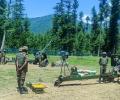
India fully utilised its military modernisation budget in 2024-2025 -- the first time in five years -- and signed a record Rs 2 trillion defence contracts.

China has made serious inroads into Latin America, which the US may now be hinting is simply not ok: Stay in your lane, Xi! In simple terms, China will no longer have access to Venezuelan oil, points out Rajeev Srinivasan.

US lawmakers have urged President Donald Trump to reconsider his proclamation on H1-B visas, including the USD 100,000 fee, asserting that Indian nationals are central to American leadership in IT and AI, and the restrictions will negatively impact US-India ties.
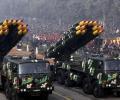
After lagging behind the broader market over the past three and six months, defence sector stocks have regained ground, reversing their performance from the past month. Concerns about slowing order inflows, execution hurdles, supply chain disruptions, and high valuations had weighed on the sector.
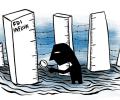
The Centre is regularly holding consultations with stakeholders to streamline foreign direct investments (FDIs) and foreign institutional investments (FIIs) related processes to enable faster and more efficient investment flows into the country, said Commerce and Industry Minister Piyush Goyal, adding one such meeting with stakeholders was held on Tuesday.

Defence Minister Rajnath Singh stated that Pakistan's entire territory is within the range of the BrahMos missile. He highlighted the missile's importance to India's armed forces during a flag-off ceremony in Lucknow.

Artificial Intelligence, innovation and next-generation technologies figured prominently during the high-stakes discussion between Prime Minister Narendra Modi and US President Donald Trump at the White House, as the two sides announced transformative measures, including the US-India TRUST initiative, roadmap on accelerating AI infrastructure and INDUS Innovation, to boost tech ties.

'There are very few issues and a political call needs to be taken about some of them.'

'Our vision is to innovate as many products as we can and solve as many problems as possible.'

'The heat shield technology for re-entry vehicles was first mastered in DRDO for the Agni missile.' 'This is why the Americans were so opposed to Agni in the 1980s, unlike other missiles -- it was a re-entry vehicle.'

'When global politics has some intervention on the core software one uses, and if you are cut off from your own data in critical workflows, sovereignty is no longer optional. It becomes a necessity.'

IIT Kanpur has announced a breakthrough in stealth technology, which would make tanks and fighter aircraft invisible, or near-invisible to enemy radar.

President Droupadi Murmu's address to the nation on the eve of the 79th Independence Day.

The two countries also signed a 'Memorandum of Agreement regarding the Assignment of Liaison Officers', which will facilitate the posting of one military officer from each country with the military of the other.

Prime Minister Narendra Modi emphasized the strong partnership between India and the UK, highlighting its importance for global stability and economic progress amidst global uncertainty. Discussions covered trade, defense cooperation, and geopolitical issues.

Venture funding in India slowed in the third quarter (Q3) of 2025 amid geopolitical uncertainty, though exit activity surged to a seven-year high, according to Venture Pulse from KPMG Private Enterprise, a quarterly report tracking investment trends globally across major regions around the world.

The National Stock Exchange (NSE) faces around 170 million cyberattacks daily, requiring a dedicated team of "cyber warriors" to work around the clock to ensure uninterrupted operations. The NSE recorded its highest-ever 40 crore (400 million) cyberattacks in a single day during 'Operation Sindoor', designed as a DDoS simulation. However, attackers failed to cause any damage due to the coordinated efforts of men, machines, and advanced technology.

Two modules published by the NCERT, Swadeshi: Vocal for Local (for middle stage) and Swadeshi: For a Self-Reliant India (for secondary stage), carry excerpts from the prime minister's Independence Day address in which he stressed that self-reliance would drive India's journey towards a Viksit Bharat.
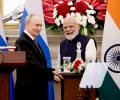
India and Russia have solidified a five-year plan to enhance their economic and trade partnership, while also addressing the ongoing conflict in Ukraine and the threat of terrorism.

The defence minister also announced that India has taken up the challenge of developing a powerful indigenous aero-engine, adding that preparations for this critical project are now almost complete and the work will soon be visible.
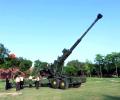
The Indian government outlines its futuristic defence programme, Sudarshan Chakra Mission, focusing on indigenous development, predictive technologies, and targeted counter-action systems to enhance national security.
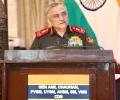
Gen Chauhan said a "whole of the nation" approach will be required to develop the shield.
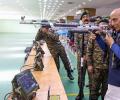
India has declared 2025 as the year of defence reforms, aiming to establish integrated theatre commands to enhance synergy among the three armed forces and transform the military into a technologically-advanced combat-ready force. The reforms will also focus on streamlining acquisition procedures, promoting collaboration, and leveraging emerging technologies like artificial intelligence and robotics.

Announcing the launch of "Mission Sudarshan Chakra", Modi said it will be aimed at neutralising enemy threat and enhancing India's offensive capabilities.
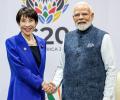
If they act now, they can reshape the strategic map of Asia without firing a shot. If they wait, the next opportunity will come only after a serious Taiwan Strait incident -- by which time the price will be far higher, and the room for boldness far smaller -- the opportunity may well be lost by then. The question is no longer whether this can or should be done, points out Varun Arya.
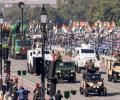
Under capital expenditure, Rs 48,614 crore has been set aside for aircraft and aero engines while Rs 24,390 crore has been allocated for the naval fleet.

Going by this Budget's estimate of government spending of Rs 48.2 trillion, the government has allocated a significantly lower percentage to defence -- 12.9 per cent.
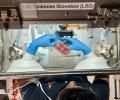
The $1.2 billion in-space manufacturing market is expected to grow and be worth more than $20 billion by 2033.
'But that was not our aim. Our objective was already achieved.'
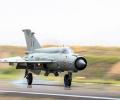
The MiG-21 episode demonstrates that procurement is always strategic.
Choices about what aircraft to acquire, who builds them, who supplies the spares, who trains the pilots and technicians are decisions with political consequences lasting for decades.

President Droupadi Murmu addressed the nation on the eve of Independence Day, praising the response to terrorism, highlighting achievements in defense self-reliance, and emphasizing unity and progress.
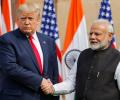
The China threat continues to resonate in the strategic partnership between India and the USA, points out Rup Narayan Das.
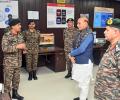
Defence Minister Rajnath Singh announced that India's defence exports have crossed a record Rs 21,000 crore, a significant jump from Rs 2,000 crore a decade ago. He set a target of achieving defence exports of Rs 50,000 crore by 2029. Singh highlighted the importance of mastering frontier technologies in the face of evolving warfare, emphasizing the role of military training centers in preparing soldiers for future challenges. He also underscored the government's commitment to strengthening integration and jointness among the three services, aiming to enhance the armed forces' ability to face challenges together.

Defence Minister Rajnath Singh emphasizes the need for India to remain prepared for uncertainty, even during peacetime, and highlights the increasing importance of the defence sector as an economic driver.

During the meeting, Gantz emphasised the opportunity to invest further in defence cooperation between the two countries.

India-US relations, like Rome, were not built in a day, nor can they be demolished in a day.
All said and done, when the new global order emerges, India can only remain with the democracies, asserts Ambassador T P Sreenivasan.
 © 2026 Rediff.com - Advertise with us - Disclaimer - Privacy Policy - Sitemap - Feedback - About us - Terms of use - Grievances